Restoration Company Profit Margin Benchmarks: Where Do You Actually Stand?
April 7, 2026
What is a good profit margin for a restoration company? Well-managed restoration companies achieve 8–15% net margin and 45–60% gross margin on water mitigation services. Margins vary significantly by service type, business mix, and operational discipline. Below 5% net margin indicates structural problems requiring diagnostic attention.
Most restoration owners don’t know how their margins compare to well-run competitors. This isn’t because the information doesn’t exist — the RIA publishes Cost of Doing Business Survey data annually, franchise networks share performance benchmarks, and industry consultants track the data across their client portfolios. The problem is that most owners are too busy running the business to access the data, and when they do access it, they don’t know how to apply it. Here are the benchmarks that matter, what drives variation, and how to use the data.
Gross Margin Benchmarks by Service Type
Gross margin is revenue minus direct costs (labor, materials, equipment, subcontractors), before overhead. It measures whether the core work is profitable at the job level.
- Water mitigation (residential): 55–70% gross margin for well-executed residential water mitigation. Below 45% indicates pricing or cost control problems.
- Fire and smoke restoration: 50–65% gross margin. Fire jobs typically have higher material costs that compress margin vs. water work.
- Mold remediation: 45–60% gross margin. Containment costs are the most commonly missed expense that compresses mold margins.
- Reconstruction: 30–45% gross margin. Lower than mitigation, but the absolute dollar margin on large reconstruction jobs can be significant.
- Commercial large loss: 40–55% gross margin. More subcontractor cost and management overhead compresses unit margins but can produce high absolute profit on large jobs.
Net Margin Benchmarks by Revenue Tier
Net margin is what’s left after overhead — the actual profit the business produces. Industry benchmarks from the RIA COBD survey and industry consulting data suggest:
- Under $2M revenue: 5–12% net margin. Small companies have high overhead-to-revenue ratios. Best performers at this size run 10–12%.
- $2M–$5M revenue: 8–15% net margin. The sweet spot for restoration profitability if overhead is managed and job costing is in place. Best performers run 12–18%.
- $5M–$10M revenue: 7–14% net margin. Growing companies often see temporary margin compression as they invest in management infrastructure. Well-managed companies maintain 10–14%.
- Over $10M revenue: 8–15% net margin. Scale provides overhead leverage. Best performers achieve 12–15%+.
Overhead Benchmarks
Overhead (indirect costs not tied to specific jobs) typically runs 30–45% of revenue. The major overhead categories and their typical ranges:
- Indirect labor (management, admin, sales): 12–18% of revenue
- Facility costs (rent, utilities, storage): 3–6% of revenue
- Vehicle and equipment overhead: 4–8% of revenue
- Marketing and business development: 2–5% of revenue
- Insurance (GL, auto, umbrella): 2–4% of revenue
- Technology and software: 0.5–1.5% of revenue
Overhead above 45% of revenue indicates structural problems. The most common: too much facility for the revenue level, excessive vehicle fleet, or indirect labor that hasn’t scaled appropriately.
What Drives Margin Variation
The gap between top performers (15%+ net margin) and average performers (5–8%) comes from five factors: job costing discipline (top performers measure margin at the job level and use the data to improve), pricing from cost up (top performers know their cost per job type and price above it consistently), commercial vs. residential mix (commercial accounts with negotiated rates often run lower margin than residential insurance work), supplement management (top performers capture 85%+ supplement approval rates), and overhead management (top performers review overhead monthly and eliminate costs that don’t produce revenue).
Frequently Asked Questions
Where can restoration companies find industry benchmark data?
The Restoration Industry Association (RIA) publishes the Cost of Doing Business (COBD) survey annually, providing benchmark data on revenue, gross margin, overhead ratios, and net margin by company size. It’s the most comprehensive restoration-specific financial benchmark available and worth reviewing annually against your own numbers.
What is the difference between gross margin and net margin?
Gross margin is revenue minus direct job costs, expressed as a percentage of revenue. Net margin is gross margin minus overhead expenses. Gross margin measures job-level profitability — “what’s left after paying for the work?” Net margin measures company-level profitability — “what’s left after paying for everything?” Both matter, and understanding the difference between them is the foundation of restoration financial management.
Is a 10% net margin good for a restoration company?
A 10% net margin is at the lower end of good for a well-run restoration company. Best-in-class operators achieve 12–18%. Below 8% indicates opportunities for improvement. Below 5% is a diagnostic red flag — typically indicating a combination of pricing problems, cost control gaps, and overhead that hasn’t been optimized for the current revenue level.
How does franchise affiliation affect restoration margins?
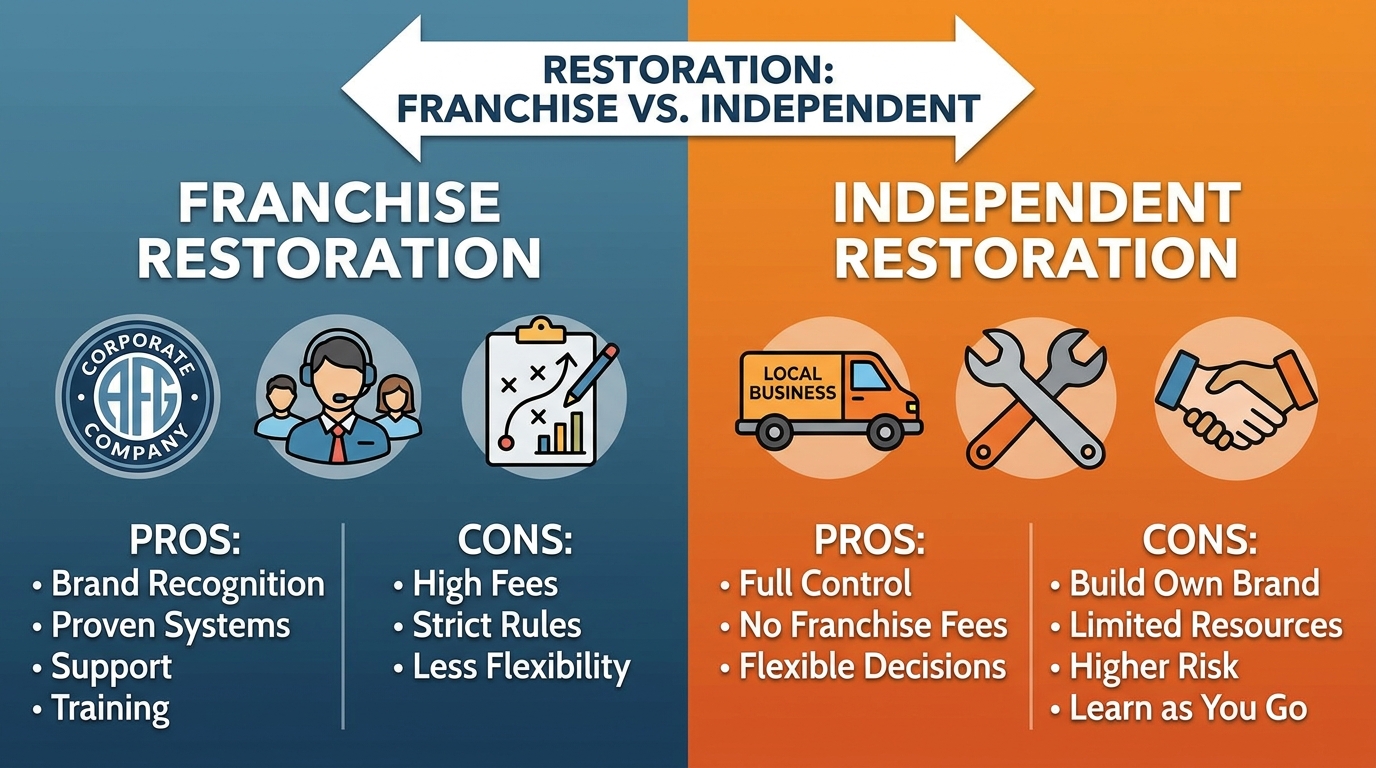
Franchise royalties (typically 5–10% of revenue) are a direct overhead cost that reduces net margin compared to independent operators with the same gross margin. The franchise benefit — brand recognition, TPA access, support systems, and peer network — should produce enough revenue premium to offset the royalty cost. Whether it does is a company-specific calculation that deserves annual review.
What is the RIA Cost of Doing Business Survey?
The RIA COBD survey is an annual industry benchmark report compiled from financial data submitted by participating restoration companies. It provides averages and ranges for revenue, margins, overhead categories, and other key financial metrics by company size. It’s the standard benchmark reference for the restoration industry and is available to RIA members.
Mike McCabe is The Profit Detective — a Master Cleaner, Master Restorer, and 36-year restoration business consultant. He has worked personally with 150+ restoration companies across North America, diagnosing the profit leaks that most owners never see on a P&L. He serves as Fractional Operations Manager at Floodlight Consulting Group and speaks at major industry events including the DKI Canada AGM. Book a free diagnostic conversation at calendly.com/profitdetective.