Overhead Control in Restoration: The Expense Lines That Kill Profit
May 1, 2026
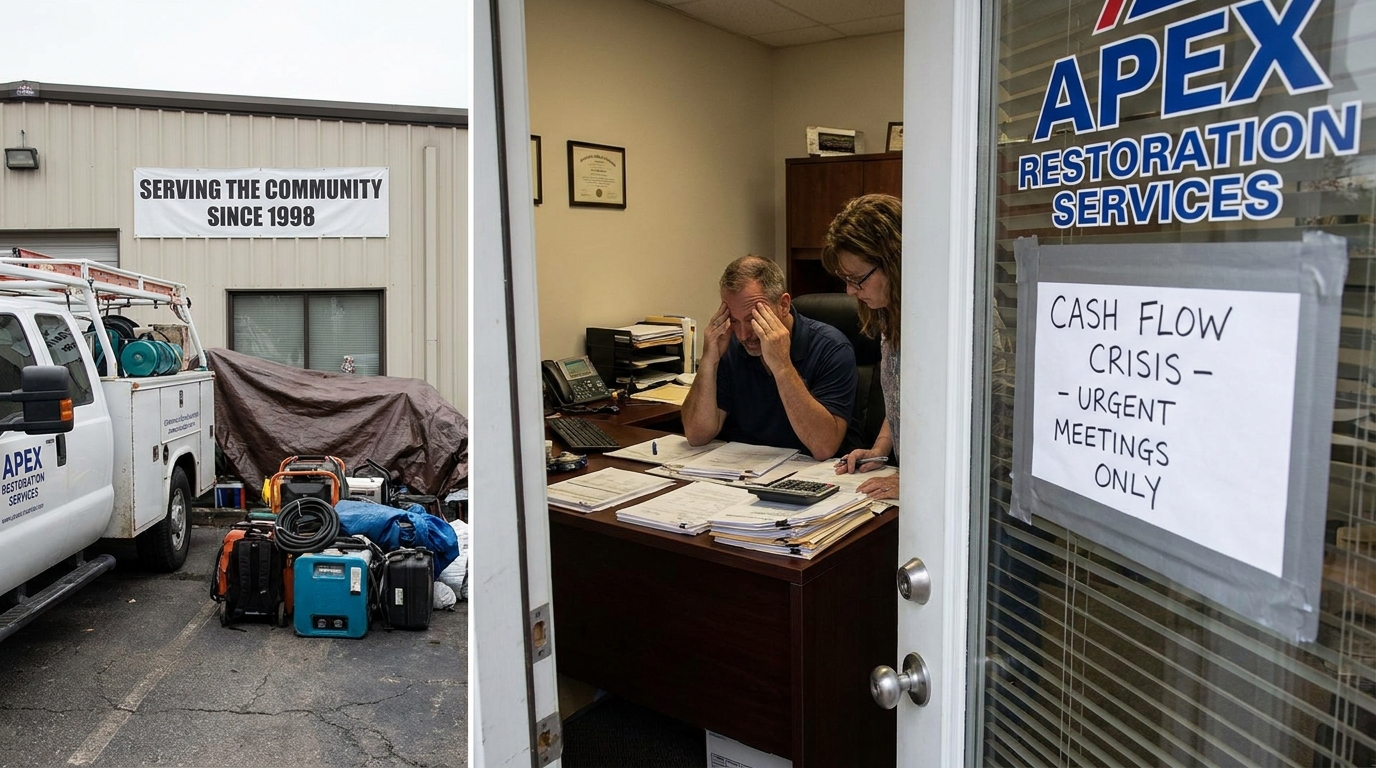
What is the right overhead ratio for a restoration company? A well-managed restoration company should run overhead at 22–28% of revenue. Companies above 30% are typically overstaffed in administrative roles, over-invested in facilities, carrying underutilized equipment, or spending excessively on vehicles relative to their revenue base.
Overhead is the silent profit killer in restoration. Unlike direct job costs, which scale with revenue, overhead is largely fixed — and when revenue plateaus or dips, overhead doesn’t shrink with it. Companies that grew into their overhead structure during high-revenue periods often find themselves in serious profit trouble when volume normalizes.
The Five Overhead Categories to Audit
1. Administrative Payroll
Administrative payroll — office staff, coordinators, estimating support, bookkeeping — should run 8–12% of revenue in a well-structured company. Above 15% is a warning sign. Common problems: too many low-productivity administrative roles, owner family members in salaried positions without commensurate output, and administrative staff hired ahead of revenue that then didn’t materialize.
2. Vehicle Fleet
Vehicle cost — payments, insurance, fuel, maintenance — is one of the most commonly over-scaled overhead categories in restoration. A useful benchmark: vehicle fleet cost should not exceed 6–8% of revenue. Companies with more vehicles than active crews are carrying overhead without corresponding revenue capacity.
3. Equipment Depreciation and Financing
Restoration equipment — air movers, dehumidifiers, specialty drying equipment — depreciates rapidly and requires regular replacement. Companies that have financed equipment purchases beyond their revenue base carry financing costs that compress margin. Benchmark: equipment-related costs (depreciation + financing) should not exceed 4–6% of revenue.
4. Facilities
Office and warehouse space costs should run 2–4% of revenue. Companies in expensive commercial real estate markets often find facilities costs at 6–8% — this is a structural overhead problem that’s difficult to reduce quickly but worth addressing at lease renewal.
5. Owner Compensation vs. Profit Distribution
Many restoration company owners take total compensation (salary + distributions) that’s appropriate for their business size but incorrectly categorize the distribution component as profit. If owner compensation is understated relative to a market salary for their role, the P&L will show phantom profit. Proper analysis requires benchmarking owner salary to market and treating excess draws as profit.
FAQ
How do I reduce overhead in my restoration company?
Overhead reduction follows a diagnostic sequence: identify the specific categories running above benchmark, determine whether the excess reflects scale mismatch (infrastructure built for revenue that didn’t materialize) or inefficiency (duplicate roles, unused space), and then address the largest variances first. Administrative payroll and vehicle fleet are typically the two categories with the most actionable reduction potential.
What should overhead be as a percentage of revenue in restoration?
Target overhead of 22–28% of revenue for a stable, mature restoration operation. During active growth investment phases, 28–32% is acceptable. Consistently above 30% in a stable-revenue environment indicates an overhead problem requiring diagnosis.
Mike McCabe is The Profit Detective — a 36-year restoration industry veteran who has identified and resolved overhead structure problems for 150+ restoration companies.