Overhead Allocation in Restoration: How to Stop Guessing at Your Real Costs
April 7, 2026
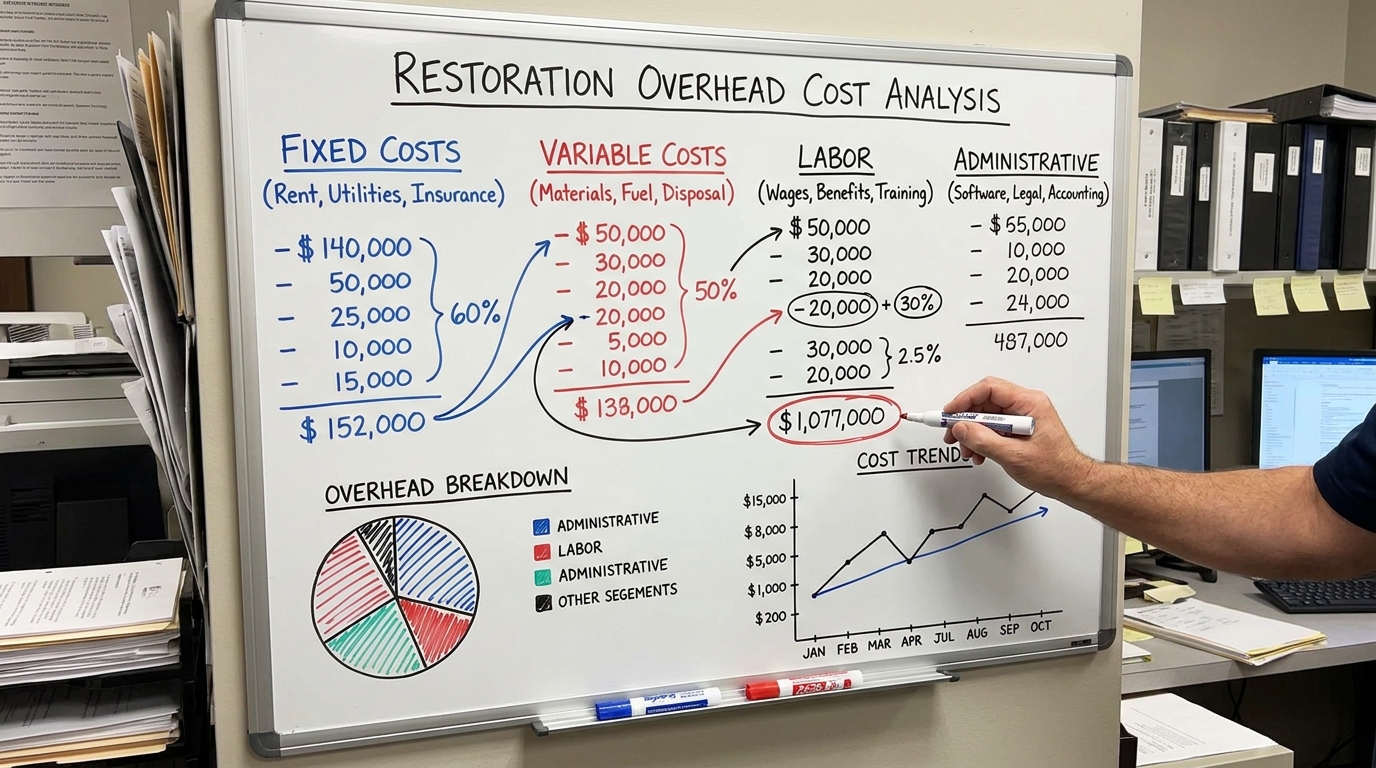
What is overhead allocation in restoration? Overhead allocation is the process of distributing indirect business costs — rent, admin salaries, insurance, vehicles, software — across individual jobs so each job bears its proportional share of the total cost of running the business. Without overhead allocation, job-level gross margin calculations overstate true profitability.
Here is a question I ask in every diagnostic engagement:
“When you look at your job margin, does it include overhead?”
Nearly every time, the answer is no. The job margin they’re looking at shows revenue minus direct costs — labor, materials, equipment, subcontractors. Overhead sits in a separate bucket on the P&L and is never connected to individual jobs.
This disconnect produces a fundamental misunderstanding of what each job actually costs — and some dangerous business decisions as a result.
Why Overhead Allocation Matters
Imagine a water mitigation job that generates $12,000 in revenue with $5,400 in direct costs. The gross margin is 55% — strong by any measure. But the company has $85,000 per month in overhead and runs 25 jobs per month. That’s $3,400 in overhead per job.
Subtract overhead from the gross profit ($6,600) and the actual job contribution is $3,200 — a 27% net margin. Not 55%. 27%.
Now run the same analysis on a $4,000 emergency service job with a 58% gross margin:
- Gross profit: $2,320
- Overhead allocation: $3,400
- Job contribution: -$1,080
This job is losing money on a fully-allocated basis. It generates gross profit but doesn’t cover its share of overhead. Without overhead allocation, the owner sees a 58% gross margin and thinks the job is profitable. With allocation, they see the truth.
The Three Overhead Allocation Methods
Method 1: Per-Job Equal Allocation
Divide total monthly overhead by number of jobs. $85,000 ÷ 25 jobs = $3,400 per job.
Advantage: Simple and easy to implement immediately.
Disadvantage: Doesn’t account for job duration or size. A $4,000 emergency call gets the same overhead allocation as a $40,000 mitigation job.
Best for: Companies at early stages of job costing who need any allocation model rather than none.
Method 2: Revenue-Proportional Allocation
Allocate overhead as a percentage of job revenue. $85,000 overhead ÷ $250,000 monthly revenue = 34% overhead rate. A $12,000 job carries $4,080 in overhead. A $4,000 job carries $1,360.
Advantage: Proportional to job value — larger jobs carry more overhead.
Disadvantage: Doesn’t account for job complexity or duration.
Best for: Most restoration companies as a strong starting point.
Method 3: Labor-Hour-Based Allocation
Allocate overhead based on field labor hours per job. $85,000 overhead ÷ 2,800 field labor hours/month = $30.36 overhead per labor hour. A job requiring 80 field hours carries $2,429 in overhead. A job requiring 200 hours carries $6,072.
Advantage: Most accurate for companies where field labor time drives most overhead consumption.
Disadvantage: Requires accurate labor hour tracking by job.
Best for: Companies with good labor hour tracking and significant variation in job size.
Implementing Overhead Allocation in Practice
You don’t need a sophisticated accounting system to start. Here’s the five-step implementation:
- Calculate your total monthly overhead — all costs except direct job costs (labor, materials, subs, equipment).
- Choose your allocation method. Revenue-proportional is the best starting point for most restoration companies.
- Apply the allocation to your job cost reports monthly. Add an overhead line to each job cost summary.
- Review fully-loaded job margins by job type. Which job types are profitable on a fully-loaded basis? Which aren’t?
- Act on the findings. Reprice unprofitable job types. Decline work that can’t be priced to cover fully-allocated costs.
What Overhead Allocation Usually Reveals
In my 36 years of running diagnostics, overhead allocation produces three consistent findings:
- Emergency service calls are often money-losers on a fully-allocated basis. They generate gross profit but are too short in duration to cover their overhead share. Companies that do high volume of small emergency calls subsidize them with larger mitigation and reconstruction jobs — often without knowing it.
- Reconstruction margin is thinner than it looks. Reconstruction jobs are long, labor-intensive, and heavily subcontracted. Their overhead allocation is substantial. The 35% gross margin that looks reasonable on a mitigation-adjusted P&L often becomes 8–12% on a fully-loaded basis.
- Overhead as a percentage of revenue creeps upward during growth phases — and owners don’t notice until the allocation model makes it visible.
Frequently Asked Questions
What is the difference between gross margin and net margin in restoration?
Gross margin is revenue minus direct job costs, expressed as a percentage of revenue. Net margin is revenue minus all costs — direct and overhead — expressed as a percentage of revenue. Gross margin answers “what’s left after paying for the work?” Net margin answers “what’s left after paying for everything?”
What overhead rate is typical for restoration companies?
Restoration companies typically run overhead at 25–35% of revenue. Below 20% is unusually lean, common in owner-operator businesses with minimal admin. Above 40% indicates overhead is growing faster than revenue and requires immediate attention.
Should restoration companies include owner salary in overhead?
Yes — at market replacement rate, not at actual owner compensation. If the owner pays themselves $180,000 but a qualified operations manager would cost $110,000, the overhead allocation should use $110,000. The $70,000 difference is owner return on equity — a separate category.
How does overhead allocation affect pricing decisions?
Overhead allocation reveals the true minimum price for each job type. Pricing above the fully-allocated cost floor produces real profit. Pricing between direct cost and fully-allocated cost produces gross profit but consumes overhead without covering it — which only works if higher-margin jobs in the same period compensate.
What should I do if overhead allocation shows certain jobs always lose money?
This is exactly the finding overhead allocation is designed to produce. When fully-allocated analysis shows a job type is consistently margin-negative, the choices are: reprice (raise rates to cover allocation), reduce (do fewer of these jobs), or restructure (reduce the overhead that makes them uneconomic).
Mike McCabe is The Profit Detective — a 36-year restoration industry veteran and Fractional Operations Manager. He has conducted overhead allocation audits for restoration companies across North America. Book a free diagnostic conversation.