PDR Files: The $4M Restoration Company That Couldn’t Make Payroll
May 1, 2026
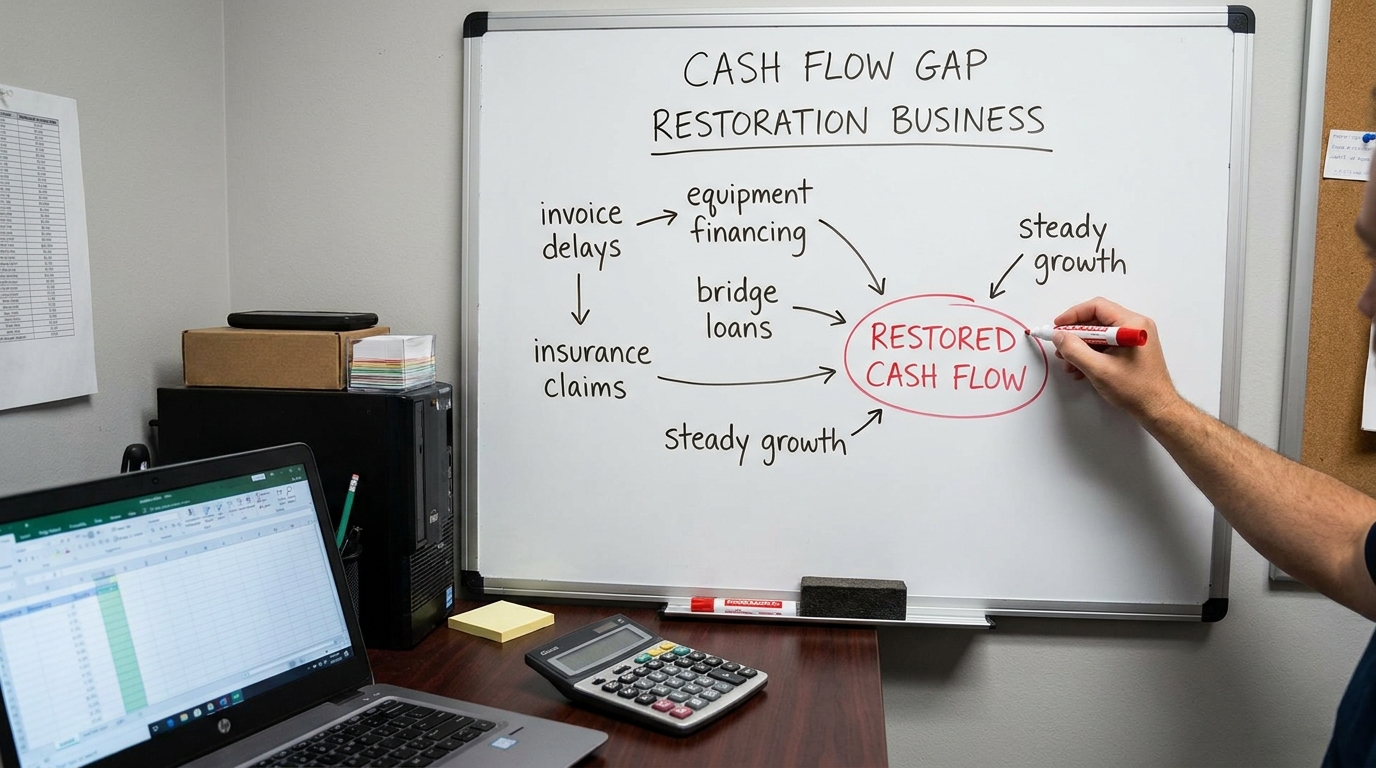
Payroll pressure in a revenue-positive restoration company typically signals a structural cash conversion problem — jobs are funded before billing, AR is aging past 60 days, overhead is misaligned with job mix, or working capital has been depleted by equipment purchases or owner draws. The presenting symptom is payroll; the root cause is almost always in the cash conversion cycle.
The Call: Four Million and Ninety Thousand Short
The owner called on a Thursday morning, two days before payroll. He needed to know if he should draw his credit line again or if there was another option. He’d been drawing it for payroll for six consecutive pay periods — twelve weeks. The line had $210,000 available. He’d drawn $180,000 of it. He was profitable, he said. His accountant had confirmed it. He just had no idea where the money was.
The company was doing $4.1M annually. Commercial mitigation and reconstruction, primarily. Sixteen full-time employees. The company had been growing — revenue was up 22% from the prior year. The growth was real. So was the payroll crisis.
The Diagnostic: Four Symptoms, One Root Cause
When I pulled the financials, four things were immediately visible: AR aging was extended (32% over 60 days); three large commercial jobs — totaling $890,000 in estimated value — had received no billing beyond the initial deposit in 45+ days; the company had purchased $185,000 in new equipment six months prior, funded partly from operating cash; and the company had added three employees ahead of the revenue growth curve, adding $240,000 in annualized payroll before the jobs they were hired to support had fully billed.
Any one of these alone would have created cash pressure. Together, they’d constructed a cash trap. But the root cause was singular: the company had been growing on a cash-funded basis — spending ahead of billing — without a working capital structure to support that pattern. The growth was real. The cash infrastructure wasn’t ready for it.
Why Commercial Work Changes the Cash Equation
The shift from primarily residential to commercial-heavy work is where most restoration cash crises develop. Residential insurance jobs typically bill and collect in 30–45 days. Commercial jobs can fund, scope, and execute for 60–90 days before meaningful billing occurs — especially on reconstruction where progress billing triggers require completion milestones. A company that was comfortably cashflow-positive on residential work can become cash-poor on the exact same margins doing commercial work, simply because the billing cycle is longer and the job size is larger.
This company’s three large commercial jobs represented approximately $890,000 in value — nearly 22% of annual revenue — sitting in various stages of execution with minimal billing. The costs to run those jobs (labor, materials, subcontractors, equipment) were flowing out of the operating account every week. The revenue was sitting in estimated job value that hadn’t converted to invoices.
The 90-Day Fix
Week one: Emergency progress billings on all three large commercial jobs. Two of the three had contractual progress billing triggers at 25%, 50%, and 75% completion. Neither had been triggered, despite one job being at approximately 65% completion. We submitted a 50% progress billing that day — $180,000. It was paid in 18 days.
Weeks two through four: AR collection focus on the over-60 accounts. Assigned the office manager to a daily call list. Of $312,000 in over-60 AR, $198,000 was collected or had committed payment dates within 30 days.
Month two: Implemented a commercial job billing protocol — no commercial job with more than $25,000 in costs incurred could go 21 days without a progress billing review. This required the PM to submit a percent-complete assessment every two weeks, triggering billing when milestones were reached.
Month three: Credit line balance went from $180,000 drawn to $40,000 drawn. Payroll funded from operating account for the first time in four months. Operating account balance stabilized above $120,000.
The Difference Between a Cash Problem and a Margin Problem
The most important thing I told this owner on the first call: “You don’t have a profitability problem. You have a cash conversion problem. Those require completely different fixes — and the cash fix is faster.” A profitability problem requires changing what you charge or what you spend. A cash conversion problem requires changing when money moves.
This distinction matters emotionally as much as operationally. Owners experiencing payroll stress often catastrophize — “the business is failing” — when the actual diagnosis is “the billing cycle is too slow for the job mix.” The business is fine. The cash infrastructure is mismatched to the work. Fix the infrastructure, and the money that already exists in the system starts flowing correctly.
FAQ: Restoration Company Payroll Cash Flow Crisis
What’s the difference between a cash flow problem and a profitability problem in restoration?
A profitability problem means the business isn’t generating enough margin — costs are too high or revenue is too low relative to overhead. A cash flow problem means the timing of when money comes in is mismatched with when it needs to go out. You can be profitable and cash-poor simultaneously — this is the most common crisis pattern in growing restoration companies. The two problems require different fixes and have very different urgency profiles.
How quickly can a restoration company fix a payroll cash flow crisis?
If the root cause is billing cadence and AR collection — which it usually is — meaningful improvement is possible within 30 days. The first progress billing submitted on a stalled commercial job, the first AR collection call that turns a 90-day invoice into a payment, these create immediate cash flow. Full stabilization — operating account balance consistent, credit line drawing stopped — typically takes 60–90 days.
What are the three most common root causes of payroll stress in a restoration company?
In order of frequency: AR aging past 60 days without active collection (earned revenue sitting uncollected), WIP costs incurred ahead of billing on large jobs (cash going out before invoices go out), and overhead structure that outpaced revenue growth (hiring and equipment purchases ahead of billing conversion). The combination of two or three of these simultaneously produces the acute payroll crisis.
How do I know if my restoration company’s cash problem is structural or temporary?
A temporary problem is event-driven: one large job delayed, one carrier slow to pay, one unexpected equipment repair. It resolves when the event resolves. A structural problem recurs across multiple billing cycles regardless of which specific jobs are open. If you’ve been drawing the credit line for payroll for three or more consecutive pay periods, the problem is structural — and it won’t resolve on its own without identifying and fixing the underlying cash conversion issue.
What role does AR aging play in restoration company payroll stress?
Extended AR is working capital locked in other people’s accounts. Every dollar sitting uncollected past 60 days is a dollar not available for payroll. On a $4M company, if 30% of AR is over 60 days — which is not unusual without active collection management — that’s potentially $100,000+ in earned revenue unavailable as operating cash. The fix is collection discipline, not more revenue: the money already exists, it just needs to move.
Mike McCabe is a restoration business consultant and the founder of Profit Detective. He works with restoration operators to find and fix the margin leaks that don’t show up until it’s too late.