PDR Files: What I Found in a $2.3M Alberta Restoration Company With No Cash
May 1, 2026
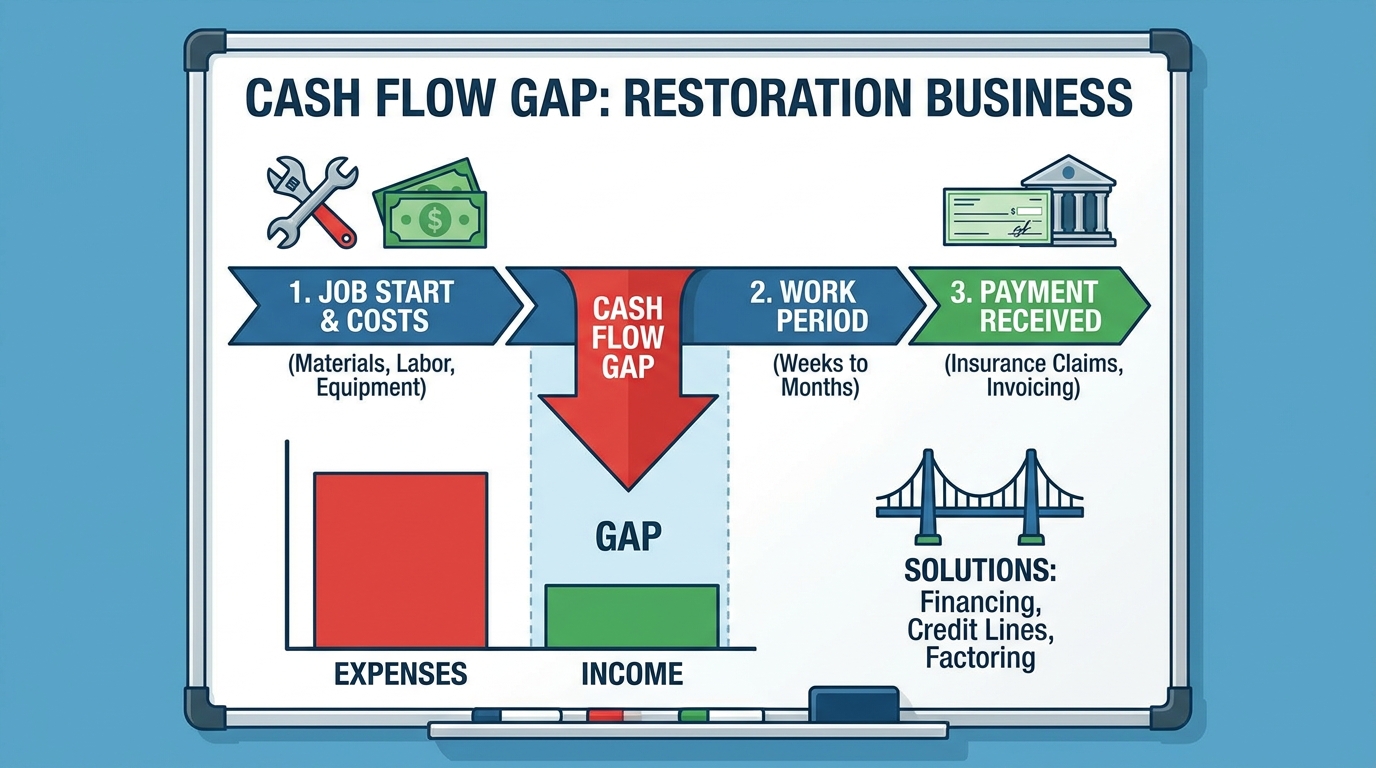
A restoration company can show strong revenue and even positive net income while running chronically short of cash when AR aging is extended (insurance slow-pay), WIP jobs are funded before billing, overhead is fixed against variable revenue, or owner draws exceed available operating cash. These are diagnostic patterns the Profit Detective identifies in the first engagement week.
The Situation: $2.3M and Making Payroll on a Credit Line
The owner called on a Tuesday afternoon and opened with a sentence I’ve heard a hundred times: “We’re doing over two million and I can’t figure out where the money is going.” He was making payroll every two weeks by drawing his line of credit. The line was nearly maxed. His accountant had told him he was profitable. His bank was getting nervous.
The company was based in Alberta — a market with strong insurance volumes and a competitive but healthy restoration landscape. $2.3M in annual billing. Twelve employees. A mix of residential water and fire work with a growing commercial account book. From the outside, it looked like a functioning business that had hit a rough patch. From the inside, the owner had been living this rough patch for eighteen months.
Week One: What the Diagnostic Found
The first thing I do in any engagement is pull the AR aging report and the last twelve months of job cost data. This company’s AR aging report told the story immediately. Of approximately $380,000 in outstanding receivables, $190,000 — exactly half — was over 60 days old. Of that, $140,000 was over 90 days. The company was billing well. The money was just sitting uncollected.
The second finding was in the WIP. The company was carrying seven large jobs in various stages of execution — total estimated value of $320,000 — none of which had issued a progress billing in the past 30 days. Jobs being actively worked, costs being actively incurred, zero billing movement. Every dollar of labor and equipment on those jobs was being funded by the operating account and the line of credit before a single invoice went out.
The third finding was the owner’s draw structure. This is the uncomfortable conversation that happens in most engagements. The owner was drawing $12,000 per month in salary plus approximately $8,000/month in personal expenses run through the business. At $240,000 annually in effective owner compensation on a company generating roughly $180,000 in net income (on paper), the math wasn’t working. The business was technically profitable. The owner was drawing past the profit line every month.
The Diagnosis: Three Separate Problems Presenting as One
What looked like “no cash” was actually three distinct problems running simultaneously: extended AR with no active collection process, WIP jobs generating costs with no corresponding billing cadence, and owner compensation that consistently exceeded available operating cash. Any one of these problems alone would have created cash pressure. All three together created the crisis.
The important distinction: this was not a profitability problem. The company’s gross margins on completed jobs were solid — 41% average across the year. The business was generating profit. The problem was timing and structure — profit was being created months after costs were incurred, and then being consumed by the draw before it could rebuild working capital.
The Fix: Three Interventions, 90-Day Timeline
Intervention 1: AR collection blitz. We identified the 15 invoices over 60 days and assigned an owner — the office manager — to work each one directly. Not automated statements. Personal calls, email chains, escalation to adjusters where needed. Within 30 days, $88,000 of the $140,000 over-90 balance was collected or had a confirmed payment date. The credit line draw stopped in week three of collection activity.
Intervention 2: WIP billing cadence. We implemented a rule: any job with more than $15,000 in costs incurred and no billing in 21 days gets a progress billing generated that week. No exceptions. The office manager ran a weekly WIP report and flagged any job violating the rule. Progress billings went out on four of the seven open jobs within the first two weeks. Three of those came back paid within 30 days of submission — $112,000 into the operating account.
Intervention 3: Owner draw restructure. This is the conversation that requires trust. The owner agreed to reduce his business expense pass-throughs and cap his combined compensation at $180,000 annually — approximately at the profit line. The framing: “You can take more out once the working capital reserve is rebuilt. You can’t take more out while the business is funding your draw from the credit line.” He agreed. It held.
The Results at 90 Days
Credit line balance went from $190,000 drawn to $45,000 drawn. Operating account balance went from running below $20,000 to maintaining above $80,000. Payroll moved off the credit line entirely in month two. The owner described week eight as the first time in eighteen months he’d made payroll without a draw.
The business didn’t change its revenue. Its margins didn’t change. Its market position didn’t change. What changed was when money moved and how much of it stayed in the business. That’s almost always the cash problem story.
The Transferable Lesson
If you’re a restoration owner making payroll on a credit line while showing solid revenue numbers, the diagnosis is almost certainly in one of three places: AR that isn’t being collected on schedule, WIP costs being funded ahead of billing, or owner compensation running past net income. None of these are complex to fix. All of them require someone willing to look at the actual numbers instead of assuming the business is fundamentally broken.
The business isn’t broken. The cash cycle is. Those are different problems with different fixes — and very different emotional landscapes for the owner trying to survive them.
FAQ: Restoration Company Cash Flow Diagnostic
Why would a $2M+ restoration company have no cash despite strong revenue?
Revenue and cash are different things. A company can bill $2M+ annually while running cash-poor if AR is aging past 60 days, WIP costs are incurred before billing, or owner draws exceed net income. The profit exists on paper; the cash exists in other people’s accounts or has been drawn out before working capital rebuilds.
What does a working capital gap look like in a restoration company’s financials?
A working capital gap shows up as a growing credit line balance that doesn’t track with revenue growth, AR aging that skews toward 60+ days, and an operating account balance that consistently runs below one month of overhead. If your credit line is your payroll funding mechanism rather than an emergency reserve, you have a working capital gap.
How long does it take to fix a cash flow problem in a restoration company?
With focused intervention, a billing and AR discipline problem can show meaningful improvement within 30–45 days — the first AR collection cycle. Full working capital stabilization typically takes 60–90 days. Owner compensation restructuring that sticks takes 90 days to validate. The fixes aren’t slow; the hard part is identifying which of the three root causes is primary.
What are the first three things a restoration owner should check when cash is consistently tight?
First: pull the AR aging report and identify everything over 60 days by dollar amount. Second: pull the WIP report and identify every job with costs incurred but no billing in the past 21 days. Third: calculate your total effective owner compensation (salary plus personal expenses through the business) and compare it to last year’s net income. The cash problem is almost always visible in one of these three places.
How does insurance AR aging create cash problems even when billing is healthy?
Insurance payment timelines are longer than commercial invoicing — 30–60 days is normal, 90+ days happens routinely when claims are complex or adjusters are backlogged. When AR ages past 60 days without active follow-up, a restoration company can have $200,000+ in earned but uncollected revenue sitting in the system while the operating account runs dry. Billing health and collection health are separate disciplines. Most companies manage billing reasonably well and collection poorly.
Mike McCabe is a restoration business consultant and the founder of Profit Detective. He works with restoration operators to find and fix the margin leaks that don’t show up until it’s too late.