Why Restoration Owners Can’t Afford to Stay the Best Technician in the Room
May 1, 2026
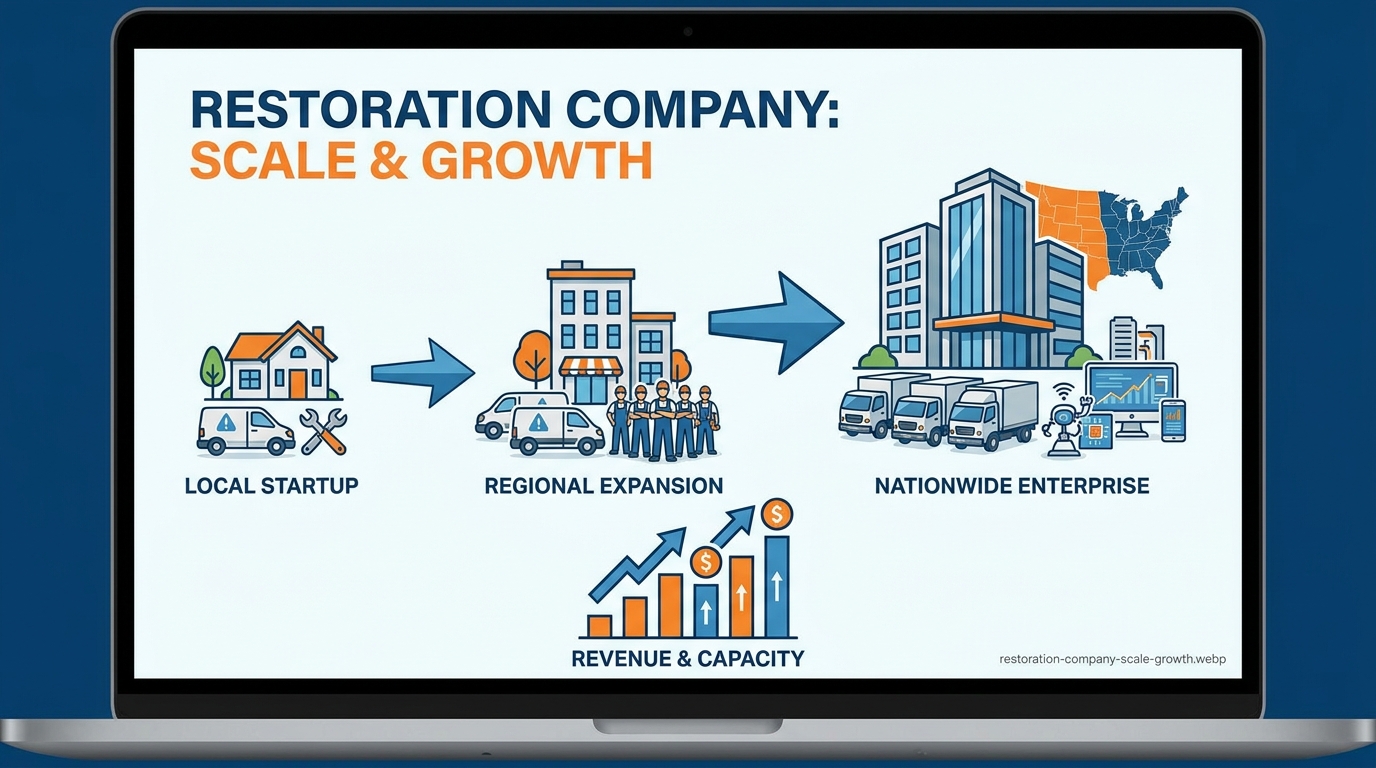
What is the owner-operator bottleneck in restoration? The owner-operator bottleneck is the growth ceiling that occurs when a restoration company’s decisions, customer relationships, and operational quality are primarily dependent on the owner’s personal involvement — making the business unable to scale beyond the owner’s individual capacity.
You built your restoration company because you were good at the work. That competence earned you a company. And now it’s holding you back.
The skills that built a $1M restoration operation are not the skills that build a $5M operation. After 36 years in this industry, this is the most consistent pattern I see: owners who are outstanding technicians, trapped inside businesses that can’t grow past their personal capacity.
How the Bottleneck Forms
It starts with good intentions. You stay involved in estimating because your estimates win more jobs. You take the calls from difficult adjusters because you know how to handle them. Each of those decisions is locally correct. But the aggregate effect is that your company cannot function without you — and a company that cannot function without you has a hard ceiling on its growth.
The Four Things You Need to Let Go Of First
1. Estimating. The highest-leverage move most restoration owners can make is developing an estimator who produces work at 85-90% of your quality — and then getting out of the way. 85-90% of your quality, applied to 3x the volume, produces far more revenue than 100% applied to whatever you personally have time to estimate.
2. Field Problem-Solving. Every time you solve a field problem personally, you prevent your project managers from learning to solve it. Build a decision framework: at what point does a problem require your involvement? Enforce it consistently.
3. Adjuster and TPA Relationships. Start introducing your PMs into these relationships now. Transfer the relationship gradually, while you’re still there.
4. Hiring Decisions. Develop a hiring profile for each role, build an interview process, and empower your operations manager to make hiring decisions for field staff.
Building the Management Layer
The most important investment a restoration owner at $3M-$8M in revenue can make is in a competent operations manager. This hire is often delayed because owners can’t see how they’ll afford it. The honest answer is that you can’t afford not to. Every month you delay is another month your personal capacity is the ceiling on your company’s growth.
Frequently Asked Questions
When should a restoration company hire an operations manager? Most restoration companies need an operations manager when they reach $3M-$5M in revenue and the owner can no longer manage all field operations personally without sacrificing business development and strategic work.
What does it cost to hire a restoration operations manager? Operations managers in restoration typically earn $75,000-$120,000 depending on market and experience. For most owners at $3M+, the revenue unlocked by their presence is well above the salary cost.
Mike McCabe is The Profit Detective — a 36-year restoration industry veteran and Fractional Operations Manager at Floodlight Consulting Group. He has personally developed and trained leadership teams across 150+ restoration companies.